Your shopping cart is empty!
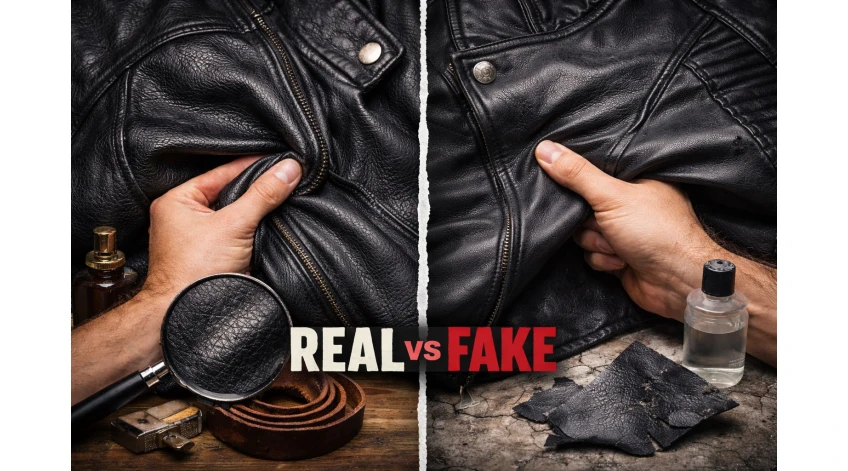

You find a leather jacket online.
It looks premium.
The price looks attractive.
But one question decides everything:
Is it real leather — or plastic pretending to be leather?
Most people assume they’ll recognize it instantly.
In reality, fake leather today looks convincing enough to fool buyers for years.
The problem is simple:
You usually discover the truth after cracking, peeling, or stiffness appears.
This guide shows how to identify genuine leather in minutes — before you buy and even after you receive it.
Real leather has natural grain variation, a warm feel, a distinct earthy smell, and develops creases where it bends. Fake leather looks uniform, feels cold or rubbery, smells chemical, and often wrinkles like plastic instead of forming natural folds.
A leather jacket isn’t just a fashion item — it’s a long-term material purchase.
Real leather:
molds to your body
ages attractively
lasts many years
Fake leather:
cracks
peels
loses structure quickly
Many buyers don’t overpay for fake leather —
they overestimate how long it will last.
The fastest visual test
Real leather is made from animal hide.
Nature never creates perfect patterns.
So genuine leather always shows:
uneven pores
subtle texture variation
inconsistent tiny lines
Fake leather shows:
repeated pattern
identical pores
machine perfection
If it looks too perfect → it probably is.
Touch the surface with your palm.
Real leather:
warms quickly
feels slightly soft
has micro-texture resistance
Fake leather:
stays cool longer
feels smooth like plastic
slightly rubbery
Now pinch and release.
Real leather forms soft wrinkles.
Fake leather forms sharp creases.
One of the most reliable indicators.
Real leather smell:
earthy
organic
warm
Fake leather smell:
plastic
chemical
synthetic
Manufacturers try to imitate the scent, but synthetic smell fades quickly while real leather scent remains subtle and natural.
Look inside seams or unfinished edges.
Real leather interior:
suede-like fibrous underside
slightly fuzzy texture
Fake leather interior:
fabric backing
woven threads visible
foam or plastic layer
This test rarely lies.
Bend the sleeve gently.
Real leather:
creates rolling folds
wrinkles spread naturally
texture deepens temporarily
Fake leather:
creates straight lines
wrinkles stay sharp
sometimes changes color at fold
Real leather behaves like skin.
Fake leather behaves like coated cloth.
Place a tiny drop of water on hidden area.
Real leather:
slowly absorbs moisture
Fake leather:
water stays on surface
Do not soak — just observe reaction.
Price alone doesn’t confirm authenticity.
Instead, check combination:
| Feature | Real Leather | Fake Leather |
|---|---|---|
| Aging | Improves | Deteriorates |
| Flexibility | Increases | Decreases |
| Texture | Changes | Stays the same |
| Smell | Natural | Chemical |
| Lifespan | Years | Short term |
Understanding this prevents confusion.
Highest durability
Natural marks visible
Ages best
Smoother surface
Slightly processed
Still genuine leather
Lower layer of hide
Still real but less durable
Plastic coated fabric
Not real leather
Many buyers mistake “genuine leather” as premium — it simply means real, not highest grade.
“Vegan leather” (synthetic)
“Leather feel material”
“Leatherette”
“Man-made leather”
“PU leather”
All indicate non-animal material.
judging only by softness
trusting product photos
assuming heavy weight = real
relying only on price
ignoring inside seams
Modern faux leather is designed to pass casual inspection.
Many people blame poor fit when the actual issue is material quality.
Link → Fit Guide Article
First weeks:
structured feel
After break-in:
softer and flexible
After months:
personalized creases
After years:
unique patina
Fake leather does not evolve — it degrades.
That’s the clearest long-term difference.
Before buying or keeping:
Check grain irregularity
Feel warmth
Smell material
Inspect inside seam
Bend sleeve
If 4/5 signs match → you know the truth.
Usually short lifespan compared to real leather, especially with regular wear.
Only if extremely dry or poorly maintained.
No. Some synthetic materials are intentionally softened.
Heavily coated leather finishes can reduce natural texture visibility.
No — branding and marketing affect pricing too.
Real leather doesn’t try to look perfect.
It looks alive.
Tiny imperfections
Natural folds
Gradual aging
Fake leather tries to stay flawless — until it suddenly fails.
Once you know what to look for, spotting real leather becomes instinctive.
And the difference isn’t just material — it’s how the jacket lives with you over time.
Knowing the material is step one — choosing the correct fit is what makes it look right.
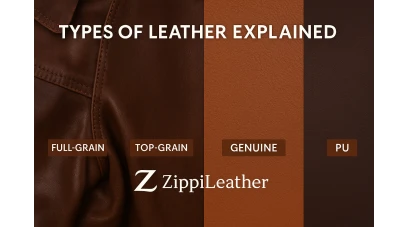
Discover the types of leather — Full-Grain, Top-Grain, Genuine & PU. ZippiLeather’s expert guide helps you spot real vs. fake leather with ease...
